
Do dental veneers mean sacrificing your natural teeth?
When people think about dental veneers, they sometimes wonder: Will my natural teeth be shaved down to tiny pegs? There is a reason this question comes up.
Social media is full of dramatic videos showing teeth filed down to tiny stubs, often poorly explained or even incorrectly presented as veneer treatment. In many cases, what you are actually seeing is preparation for full-coverage crowns, which is a different treatment altogether.
Veneers are a different story. Rather than covering the entire tooth, they are thin shells bonded primarily to the front surface. Depending on your teeth, your bite and the result you are trying to achieve, only a small amount of enamel may need to be removed, if any at all.
With veneers, less is generally more. The aim is to keep as much of your natural tooth as possible while creating enough space for a strong, natural-looking result.
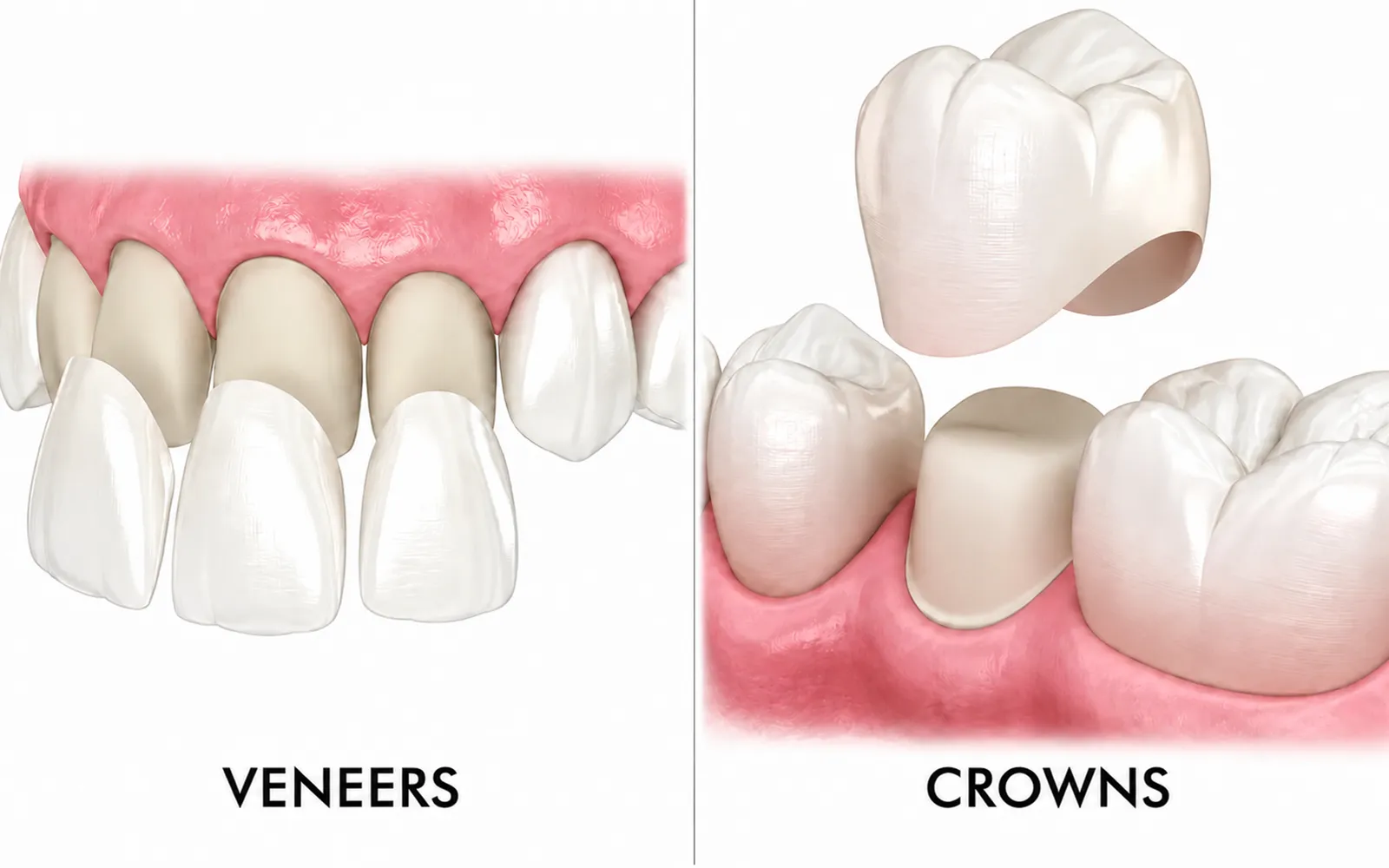
Veneers are not the same as crowns
One of the biggest misconceptions about veneers comes from confusing them with dental crowns.
A crown is designed to cover the entire visible portion of a tooth. It may be recommended when a tooth is significantly weakened, damaged or extensively restored and needs full coverage. Creating space for a crown therefore involves preparing much more of the tooth.
A veneer, on the other hand, is a thin restoration bonded primarily to the front surface of a tooth. Veneers can be used to improve the appearance of teeth affected by discolouration, chips, minor shape irregularities or small gaps.
This difference explains why some dramatic tooth-preparation videos online can be misleading. The amount of preparation required depends on the type of restoration, the condition and position of the teeth, the desired result and the treatment plan.
Veneers do not automatically require teeth to be reduced in the same way as crowns.
How much of your natural tooth is removed?
Healthy enamel is worth preserving.
It is the hard outer layer of the tooth and provides an excellent surface for bonding porcelain veneers. Research suggests that keeping veneer preparation primarily within enamel can support more predictable bonding and restoration longevity compared with preparations that extend substantially into dentine.
In some minimally prepared cases, only a very small amount of enamel, sometimes around 0.3 to 0.5 mm, may be removed. The exact amount varies between teeth and depends on factors such as their existing shape, position, colour and the result being planned.
Some teeth may require more preparation, while others may require little or none.
The important point is that veneer preparation should be planned, precise and conservative. The dentist’s aim is to create only the space needed for the restoration while maintaining as much healthy tooth structure as reasonably possible.
Preserving enamel is also important for the bonding process. Porcelain veneers are typically bonded to the tooth using adhesive resin cement, and enamel provides a favourable surface for this bond.
A conservative approach therefore serves more than aesthetics. It helps respect the natural structure of the tooth.
Are no-prep veneers right for everyone?
You may have heard of no-prep, minimal-prep or ultra-thin veneers. These approaches aim to reduce or eliminate conventional tooth preparation.
With a true no-prep approach, a veneer may be bonded directly to the existing tooth surface without removing enamel. Minimal-preparation techniques involve a small amount of reshaping or enamel reduction where necessary.
The appeal is clear: more of the natural tooth can remain intact.
However, no-prep veneers are not automatically the best option for everyone.
A veneer still adds material to the tooth. If there is not enough space, placing additional material on the front of a tooth can make it look bulky or affect the way the teeth meet. Tooth position also matters. A tooth that already sits forward, for example, may not be a good candidate for simply adding material to its front surface.
No-prep or minimal-prep treatment may be suitable for carefully selected cases involving:
- Naturally small or undersized teeth
- Minor gaps
- Subtle changes to tooth shape
- Some worn or chipped teeth
- Teeth positioned in a way that allows additional material without creating an unnatural contour
It may be less suitable when teeth are significantly crowded, rotated or prominent, or when substantial changes in shape, position or colour are required.
The most conservative treatment is not necessarily the one marketed as “no-prep”. It is the treatment that achieves the desired result while removing as little healthy tooth structure as possible.
Porcelain or composite: Which is more conservative?
The material used can also influence how much preparation is required.
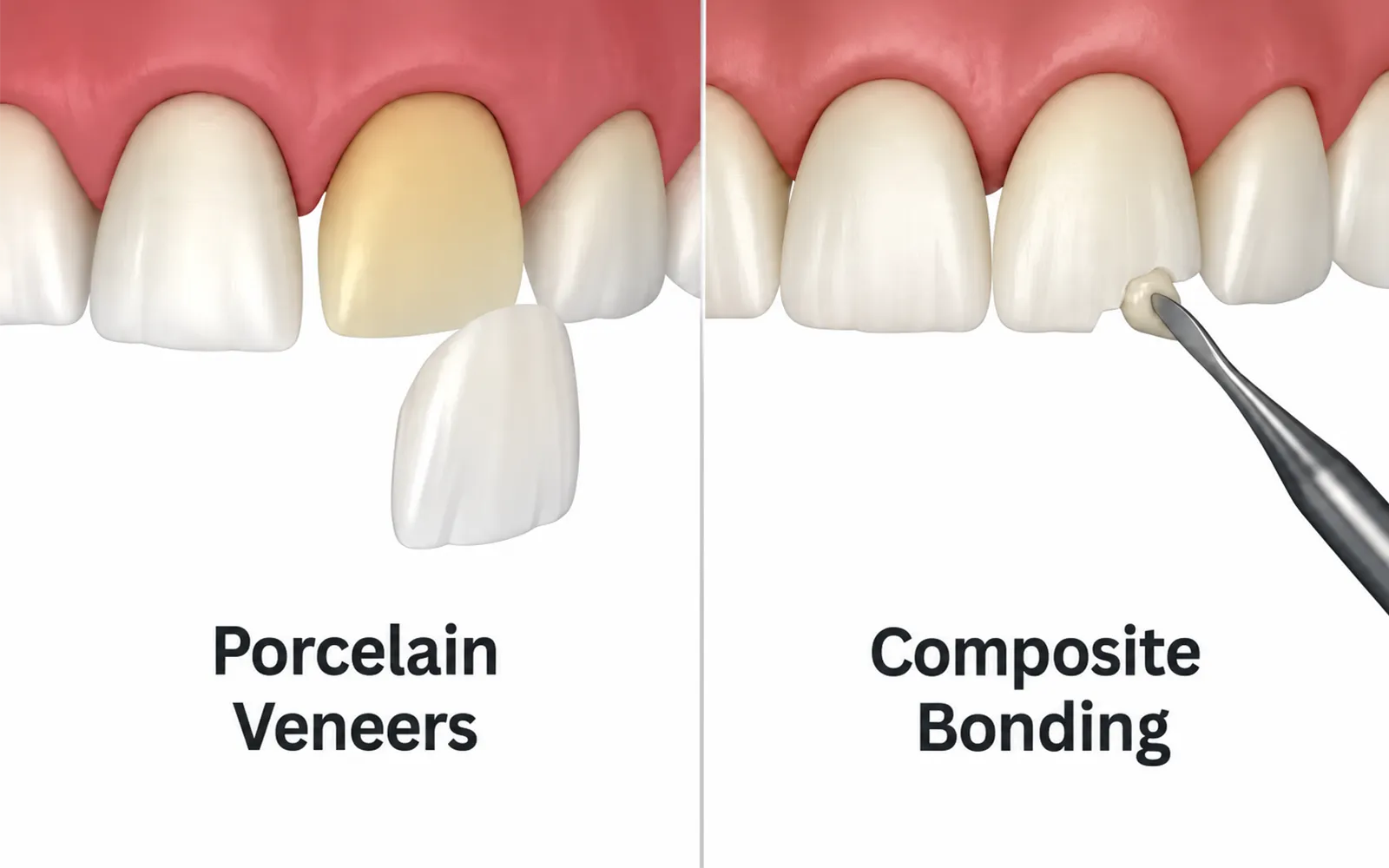
Composite bonding uses tooth-coloured resin that is applied and shaped directly on the tooth. In suitable cases, it can require little or no enamel removal and may be completed in fewer appointments. It can also be repaired or modified relatively easily.
Its trade-off is that composite can be more susceptible to staining, wear and surface changes over time than porcelain.
Porcelain veneers are custom-made restorations designed to fit the front surfaces of the teeth. They are valued for their natural appearance, colour stability and durability, and can also be placed using conservative preparation in suitable cases.
The choice is therefore not simply about which option removes the least enamel. Your dentist will consider the condition and position of your teeth, your bite, the result you want to achieve and how the restoration needs to function over time.
Are veneers reversible?
This is an important consideration before treatment.
Traditional veneers that require enamel preparation are generally not reversible. Once enamel has been removed, it does not grow back. If the veneer eventually needs to be replaced, another restoration will usually be required.
No-prep veneers can be more conservative because little or no enamel may be removed. However, they should not automatically be described as completely reversible. Bonding, surface conditioning and removal of a restoration can still affect the underlying tooth surface.
For this reason, it is worth asking exactly what will happen to your teeth before treatment begins.
A good cosmetic treatment plan should make the long-term implications clear, not just focus on the immediate result.
Can you preview your smile before treatment?
Modern cosmetic dentistry allows much of the treatment to be planned before any permanent changes are made.
Digital scans, photographs, smile design software and diagnostic mock-ups can help your dentist assess proposed changes to tooth length, width, shape and overall smile proportions.
In some cases, a temporary mock-up can also give you an opportunity to see how the proposed changes may look before final restorations are made.
This planning process can help determine whether the desired result can be achieved conservatively. It may also reveal that another treatment, such as whitening, orthodontics or composite bonding, could achieve some or all of the desired changes without veneers.
Careful planning gives both the dentist and patient a clearer understanding of what is achievable before treatment begins.
Questions worth asking before getting veneers
A veneer consultation should involve more than choosing a shade of white.
Consider asking your dentist:
- How much natural enamel would need to be removed?
- Can my treatment be completed with minimal or no preparation?
- Will the preparation remain within enamel?
- Why is preparation necessary in my particular case?
- Would composite bonding or another treatment be a suitable alternative?
- Can I see a mock-up or digital preview before preparation?
- How will my teeth and veneers need to be maintained over time?
Your dentist should be able to explain the reasoning behind the recommended treatment and discuss alternatives where appropriate.
Sometimes the most conservative option is not veneers
Preserving natural teeth also means knowing when veneers are not the most appropriate treatment.
If the main concern is tooth colour, professional whitening may provide the desired improvement without altering the tooth structure.
If tooth position is the concern, orthodontic treatment may be a more suitable approach. For a small chip, gap or shape irregularity, composite bonding may offer a conservative alternative.
Veneers can be an excellent option when they are appropriate, but they should not be treated as the automatic answer to every cosmetic concern.
The best treatment is often the one that achieves the desired improvement while changing the natural teeth as little as possible.
Preserving your natural teeth is part of the treatment
Getting veneers does not have to mean sacrificing healthy natural teeth.
Modern cosmetic dentistry can often achieve significant aesthetic changes while preserving much of the natural tooth structure. Conservative preparation, enamel-focused bonding and carefully selected minimal- or no-prep techniques can all have a role.
The right approach depends on your individual smile. Tooth shape, position, colour, existing restorations, bite and the result you want to achieve all influence the treatment plan.
If you are considering veneers, start with a thorough consultation rather than a treatment trend. Ask how much tooth structure would be changed, why that change is necessary and whether a more conservative alternative could achieve the same result.
A beautiful smile should still have a healthy foundation.
With the right planning and ongoing preventive care, you can work towards a smile you love while continuing to protect the natural teeth that support it.